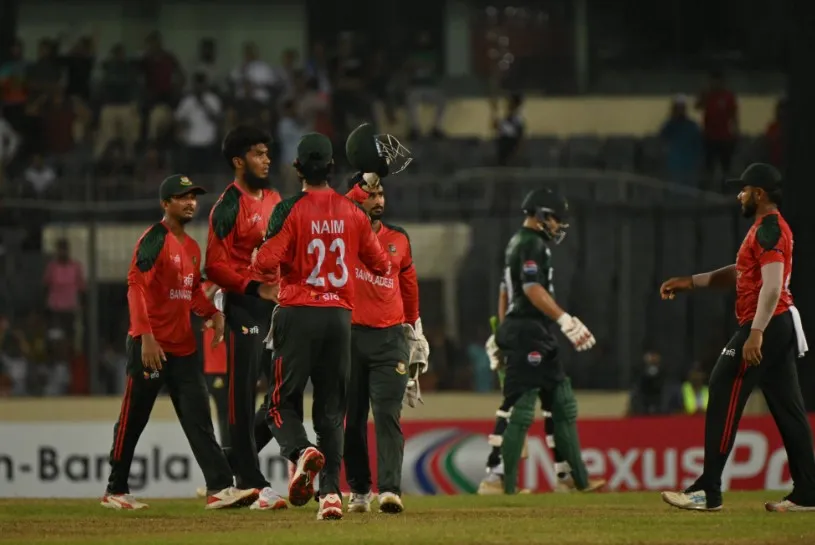
২০০০ সালে টেস্ট মর্যাদা পাওয়ার পর থেকে বাংলাদেশ দলকে টেস্টে নেতৃত্ব দিয়েছেন ১৪ জন অধিনায়ক। সবচেয়ে বেশি টেস্টে অধিনায়ক মুশফিকুর রহিম (৩৪), আর সবচেয়ে বেশি জয় নাজমুল হোসেন শান্তর (২১ টেস্টে ৯ জয়)। প্রথম টেস্ট অধিনায়ক ছিলেন নাঈমুর রহমান।
সূত্র: উইকিপিডিয়ার “List of Bangladesh national cricket captains” (আগস্ট ২০২৬-এর অস্ট্রেলিয়া সফর পর্যন্ত হিসাব), ফল মিলিয়ে দেখা হয়েছে ESPNcricinfo Statsguru-র বাংলাদেশ টেস্ট ফলাফলের সঙ্গে। যাচাই ১৯ অক্টোবর ২০২৬।
বাংলাদেশের সব টেস্ট অধিনায়ক
#
অধিনায়ক
টেস্ট
জয়
হার
ড্র
১
নাঈমুর রহমান
৭
০
৬
১
২
খালেদ মাসুদ
১২
০
১২
০
৩
খালেদ মাহমুদ
৯
০
৯
০
৪
হাবিবুল বাশার
১৮
১
১৩
৪
৫
মোহাম্মদ আশরাফুল
১৩
০
১২
১
৬
মাশরাফি বিন মর্তুজা
১
১
০
০
৭
সাকিব আল হাসান
১৯
৪
১৫
০
৮
মুশফিকুর রহিম
৩৪
৭
১৮
৯
৯
তামিম ইকবাল
১
০
১
০
১০
মাহমুদউল্লাহ
৬
১
৪
১
১১
মমিনুল হক
১৭
৩
১২
২
১২
লিটন দাস
১
১
০
০
১৩
নাজমুল হোসেন শান্ত
২১
৯
১১
১
১৪
মেহেদী হাসান মিরাজ
২
১
১
০
অক্টোবর ২০২৬-এ আবুধাবিতে আফগানিস্তানের বিপক্ষে একমাত্র টেস্টে (ড্র) বাংলাদেশকে নেতৃত্ব দেন লিটন দাস; সেটি যোগ করলে লিটনের রেকর্ড ২ টেস্টে ১ জয়, ১ ড্র।
উল্লেখযোগ্য তথ্য
প্রথম টেস্ট জয়: হাবিবুল বাশারের নেতৃত্বে, ২০০৫ সালে চট্টগ্রামে জিম্বাবুয়ের বিপক্ষে।
সবচেয়ে বেশি জয়: নাজমুল হোসেন শান্ত (৯)। তাঁর অধীনে ২০২৪ সালে পাকিস্তানের মাটিতে ২–০ সিরিজ জয় এবং ২০২৬ সালের আগস্টে ডারউইনে অস্ট্রেলিয়ার বিপক্ষে ৯ উইকেটের জয়।
সবচেয়ে বেশি ম্যাচ: মুশফিকুর রহিম (৩৪ টেস্ট, ৭ জয়, ৯ ড্র)।
এক টেস্টের অধিনায়ক: মাশরাফি বিন মর্তুজা (জয়) ও তামিম ইকবাল (হার)।
প্রশ্নোত্তর
বাংলাদেশের প্রথম টেস্ট অধিনায়ক কে?
নাঈমুর রহমান দুর্জয়, ২০০০ সালে ভারতের বিপক্ষে বাংলাদেশের অভিষেক টেস্টে।
Quick answer: Bangladesh have three Test hat-tricks. Alok Kapali took the first against Pakistan in Peshawar in 2003, Sohag Gazi the second against New Zealand in Chattogram in 2013, and Hasan Mahmud the third against Afghanistan in Abu Dhabi on 11 October 2026. Hasan Mahmud is the first Bangladesh fast bowler to do it; Kapali and Gazi were spinners.
Every Bangladesh Test hat-trick
#
Bowler
Opponent
Venue
Date
Wickets
1
Alok Kapali (spin)
Pakistan
Arbab Niaz Stadium, Peshawar
29 Aug 2003
Shabbir Ahmed, Danish Kaneria, Umar Gul
2
Sohag Gazi (spin)
New Zealand
Zahur Ahmed Chowdhury Stadium, Chattogram
13 Oct 2013
Corey Anderson, BJ Watling, Doug Bracewell
3
Hasan Mahmud (pace)
Afghanistan
Zayed Cricket Stadium, Abu Dhabi
11 Oct 2026
Ismat Alam, Qais Ahmad, Zia-ur-Rehman
Hasan Mahmud, Abu Dhabi 2026
On day three of the one-off Test, Afghanistan were 219/4 with captain Rahmat Shah set. Ebadot Hossain bowled Ikram Alikhil, and in the 83rd over Hasan Mahmud bowled Ismat Alam, had Qais Ahmad caught behind by Litton Das and trapped Zia-ur-Rehman lbw – the last one after Bangladesh reviewed a not-out call. Afghanistan lost their last six wickets for 21 runs and were all out for 240, with Rahmat Shah unbeaten on 105. Hasan finished with 5/55 and Bangladesh took a 106-run first-innings lead. It was Bangladesh’s first Test hat-trick in 13 years.
Sohag Gazi, Chattogram 2013
Gazi’s hat-trick came in the first Test against New Zealand, in the same match in which he made an unbeaten 101 – his maiden Test hundred. That made him the first player to score a century and take a hat-trick in the same Test match.
Alok Kapali, Peshawar 2003
Kapali’s leg-spin removed Shabbir Ahmed, Danish Kaneria and Umar Gul in Pakistan’s first innings to give Bangladesh their first Test hat-trick, less than three years after the team’s Test debut in November 2000.
FAQ
How many Test hat-tricks does Bangladesh have? Three: Alok Kapali (2003), Sohag Gazi (2013) and Hasan Mahmud (2026).
Who is the first Bangladesh pacer to take a Test hat-trick? Hasan Mahmud, against Afghanistan in Abu Dhabi on 11 October 2026.
Who took Bangladesh’s first Test hat-trick? Alok Kapali, against Pakistan at Peshawar on 29 August 2003.
Results (tri-series complete): 17 Oct: Zimbabwe beat Bangladesh by 99 runs. Zimbabwe 271/8, Bangladesh 172 (33.4 overs). 19 Oct: Afghanistan beat Zimbabwe by 158 runs. Afghanistan 294, Zimbabwe 136 (Sediqullah Atal 102, Rashid Khan 4/17). 21 Oct (Sharjah): Afghanistan beat Bangladesh by 7 wickets. Bangladesh 160 (41.2 overs), Afghanistan 161/3 (35.3 overs). Player of the match: Rashid Khan (4/31). 23 Oct, Final (Sharjah): Afghanistan beat Zimbabwe by 7 wickets to win the title. Zimbabwe 169 (43.3 overs, Sikandar Raza 68), Afghanistan 170/3 (34.3 overs, Ibrahim Zadran 70*). Bangladesh lost both group matches and did not reach the final. Source: ESPNcricinfo (checked 24 October 2026).
Bangladesh, Afghanistan and Zimbabwe play an ODI tri-series in the United Arab Emirates from 17 to 23 October 2026. Bangladesh open against Zimbabwe on 17 October and face Afghanistan on 21 October, and the top two teams meet in the final on 23 October. The series comes straight after the one-off Afghanistan vs Bangladesh Test in Abu Dhabi (9–13 October).
Tri-series fixtures
Date
Match
Saturday, 17 October
Bangladesh vs Zimbabwe
Monday, 19 October
Afghanistan vs Zimbabwe
Wednesday, 21 October
Afghanistan vs Bangladesh
Friday, 23 October
Final (top two teams)
The fixtures were announced together with the Test, as reported by The Business Standard. The series has now finished; results for all four matches are in the box at the top of this page.
How the format works
Each team plays the other two once in the group stage. The two teams with the most points go through to the final on 23 October. If teams finish level on points, net run rate normally decides who goes through, so the margin of each win matters as well as the result.
What to watch for Bangladesh
Back-to-back formats: the squad moves from a five-day Test to 50-over cricket within four days, so player workload and squad changes are worth following.
UAE conditions: pitches there have traditionally slowed down as matches go on, which tends to help spinners and can make chasing harder in day games.
Opening match vs Zimbabwe: a win on 17 October puts Bangladesh in a strong position before the Afghanistan game.
Quick answers
When does Bangladesh play in the tri-series? 17 October against Zimbabwe and 21 October against Afghanistan, plus the final on 23 October if they qualify.
Has the tri-series finished? Yes. All four matches have been played; see the results at the top of this page.
West Indies were bowled out for 171 (Sherfane Rutherford 56). India reached 172/2 with 32 balls to spare, led by Shreyas Iyer’s unbeaten 102 off 43 balls. The five-match series later finished 2–2 after the Bengaluru decider on 17 October was washed out. Updated 22 October 2026 (sources: Khaleej Times, CricTracker).
India hosted West Indies in the first match of a five-game T20I series on Tuesday, 6 October 2026 at the Ekana Cricket Stadium in Lucknow. The match started at 7:30 PM Bangladesh time (7:00 PM IST). Shreyas Iyer captains India and Shai Hope leads West Indies.
India vs West Indies 1st T20I: match details
Date
Tuesday, 6 October 2026
Venue
Ekana Cricket Stadium, Lucknow
Bangladesh time
7:30 PM (toss around 7:00 PM)
India time
7:00 PM IST
Series
1st of 5 T20Is (6–17 October)
The schedule and start time are taken from Outlook India’s series guide, which lists a 7:00 PM IST start for every match.
Lucknow conditions
The Ekana Stadium has a reputation for slower surfaces than many Indian venues, and spinners have often been effective in the middle overs there. Evening dew is common in October, which can make gripping the ball harder for the side bowling second. Teams that win the toss at night venues in India frequently choose to chase for this reason.
In India, the match is on the Star Sports network and the JioHotstar app. Broadcast arrangements in Bangladesh can differ, so check local sports channels on the day. Live scores are available on major cricket websites.
Quick answers
India vs West Indies 1st T20I Bangladesh time? 7:30 PM on Tuesday, 6 October 2026.
Where is the first T20I? Ekana Cricket Stadium, Lucknow.
Start times can change because of weather. Check official updates on match day.
Which pitch is best depends entirely on what you are trying to do with it – a surface built for batting rarely rewards a fast bowler, and a pitch that helps spin rarely helps pace. This guide answers the question directly for each situation: batting, fast bowling, and spin, so you can read a pitch report before a match and know what to expect rather than guessing from the color of the surface alone.
Key takeaways
Which pitch is best always depends on the situation: a dry, flat pitch with little grass favors batting and spin as the match goes on.
A hard pitch with even bounce and some pace in the surface favors fast bowlers, especially early on.
A green, grassy pitch helps seam and swing bowling, particularly on day one.
Most pitches change character as a match goes on, so the best surface for bowling early is rarely the best surface for batting late.
Reading a pitch report before a match tells you more than the venue’s reputation alone.
Pitch type
Surface signs
Best for
Flat / dry
Little grass, even surface, no cracks
Batting
Hard / grassy
Visible grass cover, firm underneath
Fast bowling (especially early)
Worn / cracked
Dry, breaking up, loose footmarks
Spin (especially later in a match)
Which pitch is best for batting
A flat, dry pitch with even bounce and little grass on it is best for batting. The ball comes onto the bat predictably, there is no unexpected seam movement, and batters can commit to their shots with confidence. These are the surfaces where big totals and long partnerships are common, and where a batting side chooses to bat first without hesitation after winning the toss. When the question is which pitch is best for a side stacked with top-order batters, this is the surface they are hoping for.
Which pitch is best for fast bowlers
A hard, well-grassed pitch with pace and even bounce is best for fast bowlers. Grass on the surface helps the ball seam off the pitch, while hardness underneath keeps the bounce consistent instead of low and unpredictable. These conditions are usually strongest early in a match, before the sun and repeated play wear the grass down and slow the surface. For a new-ball attack built around pace, this early window is when the answer to which pitch is best matters most.
Which pitch is best for spin
A dry pitch that is breaking up, with cracks or loose, powdery footmarks, is best for spin bowling. As the top layer wears away later in a match, the ball grips the surface more and turns sharper, which is why spinners tend to become more effective on days three, four, and five of a longer match rather than on day one. Late in a match, this is usually which pitch is best for a team built around spin.
How pitch conditions change over the course of a match
No single pitch stays the same for an entire match. A pitch that helps fast bowlers on day one, when the grass is fresh and the surface is hard, often turns into a pitch that helps batters by day two once the top layer has been worn down and the bounce evens out. By days three to five, the same surface can start breaking up and turning into the kind of pitch that helps spin bowling instead. This is why the toss matters so much in longer formats – the team batting last is often facing a very different pitch than the team that batted first, and which pitch is best can flip completely between the start and end of the same match.
How to read a pitch report before a match
Three things to check in any pitch report: how much grass is left on the surface, how dry or cracked the soil looks, and how the pitch played in recent matches at that same ground. A pitch described as “green” or “grassy” points toward fast bowling conditions, “dry” or “cracked” points toward spin later in the match, and “flat” or “true” points toward batting.
Combining the pitch report with recent scores at the same venue gives a much more reliable read than judging color alone, and together they answer which pitch is best before a ball is even bowled. The MCC’s official Laws of Cricket cover how a pitch is defined and maintained, if you want the formal reference point.
Common mistakes when judging a pitch
Getting which pitch is best wrong usually starts with one habit: judging a pitch purely by its color on day one and assuming it will play the same way for the rest of the match. A green pitch on the first morning can flatten out completely by the afternoon once the early moisture burns off, while a pitch that looks dry and flat at the start can still break up and turn sharply by the final day.
A second mistake is ignoring how a pitch has historically played at that specific ground. Some grounds consistently produce batting-friendly surfaces regardless of how the pitch looks a day before the match, while others are known for helping spin no matter what the surface looks like on the morning of play. Recent history at the venue is often a better guide than the pitch’s appearance alone.
Why pitch conditions matter beyond the players
Understanding which pitch favors which style is not just useful for players and coaches – it also explains a lot about how a match is likely to unfold, including which team’s bowling attack is better suited to the conditions and how a team’s team sheet is likely to be built. Bangladesh’s own recent matches are a good example of how conditions shape outcomes, and the batting consistency questions raised around the Bangladesh vs Australia Test series often trace back to how the surface behaved on each day rather than just individual form. The ICC, as the sport’s global governing body, sets the playing conditions that define how much this can vary between venues.
The same logic applies when comparing bowling attacks – a lineup built around raw pace, like the bowlers covered in our look at the fastest bowlers in world cricket, is set up to exploit exactly the hard, grassy conditions described above, while a spin-heavy attack is built for the dry, worn surfaces that appear later in a match. Boards like Cricket Australia publish their own groundskeeping notes for exactly this reason.
Frequently asked questions about which pitch is best
1. Which pitch is best overall, batting or bowling?
There is no single “best” pitch overall – it depends on the situation. Flat, dry pitches favor batting; hard, grassy pitches favor fast bowling; worn, cracked pitches favor spin.
2. Does a green pitch always help fast bowlers?
Usually only early in a match. As the grass wears down and moisture burns off, a green pitch often flattens out and starts favoring batting instead.
3. Why do spinners do better later in a match?
Because the pitch surface wears down and dries out as a match progresses, creating cracks and rough patches that grip the ball and produce sharper turn.
4. Can a flat pitch turn into a bowling-friendly pitch?
Yes, particularly for spin. A pitch that looks flat and dry at the start of a longer match can still break up and turn sharply by the final day.
5. Is the toss more important on some pitches than others?
Yes. On pitches that are expected to break up significantly by the later stages, winning the toss and batting first matters far more than on a pitch expected to stay flat throughout.
Final word
There is no universal answer to which pitch is best – the right surface depends on whether you are looking at it from a batting, fast-bowling, or spin perspective, and on how far into the match play has gone. Reading grass cover, dryness, and recent history at the venue together gives a far more reliable picture than judging a pitch by its color alone. For a broader look at how surfaces are classified, see our guide to cricket pitch types.
Pakistan collapse became one of the biggest cricket talking points of 9 September after England dismissed the tourists for only 133 on day one of the third Test at Edgbaston. Pakistan lost their entire innings in 33.5 overs, with captain Babar Azam making seven and England’s fast bowlers taking all ten wickets.
The Pakistan collapse was particularly damaging because this was already a must-improve match for the visitors. England entered the final Test with an unassailable 2-0 series lead after victories at Headingley and Lord’s. The immediate question was simple: why did Pakistan fall apart again despite making major changes before Edgbaston?
Pakistan Collapse: What Happened at Edgbaston?
England chose to field and immediately put Pakistan’s reconstructed batting order under pressure. Pakistan’s top five all failed to reach double figures. Shan Masood made six, Abdullah Shafique three and Babar Azam seven, while several of the newer players also struggled against England’s pace attack.
By the time Babar was dismissed, Pakistan were 48 for five. The Pakistan collapse continued despite Saud Shakeel attempting to rebuild the innings. Shakeel made 43, comfortably the best score in Pakistan’s first innings, while Mohammad Abbas added 21 lower down the order.
Those contributions were not enough to prevent Pakistan being dismissed for 133. The score itself tells only part of the story: England kept taking wickets before any partnership could become secure.
Why Was the Pakistan Collapse So Severe?
The most obvious factor was England’s fast bowling. Josh Tongue finished with 4-42, while Ollie Robinson took 3-15 and Jofra Archer claimed 3-25. Every Pakistan wicket fell to a pace bowler.
Tongue’s dismissal of Babar attracted particular attention. The Pakistan captain was bowled for seven, leaving his team in even deeper trouble during the first session. The Pakistan collapse was therefore not caused by one isolated dismissal. England repeatedly attacked the stumps and forced Pakistan’s batters to make decisions against movement and pace.
Pakistan also had very little opportunity to recover because wickets fell in clusters. A batter could settle briefly, but there was rarely enough support at the other end to turn survival into a meaningful partnership.
Pakistan Collapse Followed Major Selection Changes
The timing made the result even more significant. Pakistan had changed their squad heavily before the third Test as the team searched for a response after losing the first two matches.
Babar had urged his players to perform with greater freedom before the match. Instead, the Pakistan collapse meant the new-look side immediately found itself under pressure. That makes “why did Pakistan collapse against England?” a stronger search question than simply reporting the score.
Tongue produced the best bowling figures of the innings. His four wickets included Babar Azam and Saud Shakeel, two of the batters Pakistan would have expected to provide stability.
Shakeel had at least given Pakistan a chance to move towards a more competitive total. Once Tongue removed him for 43, the possibility of a substantial recovery disappeared. The Pakistan collapse was completed when the innings ended at 133 after only 33.5 overs.
Babar made seven. That dismissal mattered beyond the individual number because Pakistan were already struggling badly when their captain departed.
A captain cannot rescue every innings, but Pakistan needed experience after making significant squad changes. Instead, Babar became another early wicket in the Pakistan collapse.
Could Pakistan Still Recover in the Third Test?
A first-innings total of 133 left Pakistan with very little margin for error. England moved into their reply with the opportunity to establish a substantial first-innings advantage, having already dominated the first two Tests.
Test cricket can still change quickly if conditions remain favourable to seam bowling. Pakistan’s best route back into the contest was therefore clear: take early England wickets and prevent the hosts from building a decisive lead.
The Pakistan collapse did not automatically decide the Test, but it made Pakistan’s task considerably harder and increased the scrutiny on both selection and batting execution.
Why This Pakistan Collapse Matters
There is a bigger story behind 133. Pakistan entered Edgbaston trying to end a difficult series positively after heavy defeats in the opening matches. They also arrived with changes to personnel and intense scrutiny around the team.
The Pakistan collapse means those changes will now receive even more attention. Selection, batting technique, confidence and Pakistan’s ability to compete in English conditions are all legitimate questions after such a short innings.
What should not be done is inventing dressing-room explanations without evidence. The verified story is already strong enough: Pakistan changed their squad, entered the final Test 2-0 down, lost their top five cheaply and were bowled out for 133 by England’s pace attack. Read more latest news and sports updates on Agents Notout.
Conclusion
The Pakistan collapse at Edgbaston was built around repeated top-order failures and excellent England fast bowling. Josh Tongue led the attack with four wickets, Robinson and Archer took three each, and Saud Shakeel’s 43 was the only substantial resistance.
Pakistan now need a major bowling response if they are to stop England turning 133 into another dominant position.
FAQ
1. Why did Pakistan collapse for 133?
Pakistan lost regular early wickets against England’s pace attack, while their top five all failed to reach double figures.
2. How many runs did Babar Azam score?
Babar Azam was dismissed for seven during Pakistan’s first innings.
3. Who took the most wickets for England?
Josh Tongue took 4-42, the best figures of the Pakistan innings.
Cricket Pitch Types can completely change the way a match is played. A surface with fresh grass may help fast bowlers move the ball, while a dry and worn pitch can bring spin bowlers into the contest.
The pitch is more than the strip between the wickets. It influences team selection, batting technique, bowling plans, the toss decision, and even how a match develops from one day to the next. For more news, expert match previews, and analysis, visit Agents Notout.
What Is a Cricket Pitch?
A cricket pitch is the rectangular central area where the bowler delivers the ball and the batter plays it. Under MCC Law 6, a standard pitch measures 22 yards, or 20.12 metres, in length and 10 feet, or 3.05 metres, in width.
The ground authority prepares the surface before the match, while the umpires control its use and maintenance after play begins. The umpires are also responsible for deciding whether the pitch remains safe and suitable for play.
Terms such as green, flat, dry, dusty, and damp are common descriptions rather than official legal categories. However, these descriptions help players and fans understand how different surfaces may behave.
Why Cricket Pitch Types Matter
Cricket Pitch Types affect how much the ball bounces, seams, spins, or slows after hitting the surface. Even a talented team may struggle if its players fail to adjust to the conditions.
A pitch can influence:
whether a captain chooses to bat or bowl first
the number of fast bowlers or spinners selected
the safest batting technique
the likely scoring rate
how conditions change later in the match
The ICC assesses international pitches after matches and considers factors such as bounce, seam movement, turn, consistency, and the balance between batting and bowling.
5 Common Cricket Pitch Types Explained
Pitch type
Main feature
Usually benefits
Typical effect
Green pitch
Visible grass and moisture
Seam bowlers
Movement and challenging batting
Hard pitch
Firm, compact surface
Fast bowlers and stroke-makers
Pace and higher bounce
Flat pitch
Even surface with limited movement
Batters
Easier scoring and longer partnerships
Dry or dusty pitch
Loose, cracked surface
Spin bowlers
More turn and variable bounce
Damp pitch
Moist, soft surface
Seam bowlers
Slow pace and unpredictable movement
1. Green Cricket Pitch Types
Green pitches contain a noticeable covering of live grass. The grass can help the ball retain its seam and move sideways after bouncing, especially when the surface also contains moisture.
Fast bowlers often target a good length and allow the pitch to create movement. Batters may need to play late, leave deliveries outside the off stump, and avoid driving too early.
Green Cricket Pitch Types can become easier for batting once the moisture disappears and the surface settles. Therefore, a difficult opening session does not always mean the entire match will remain bowler-friendly.
2. Hard and Bouncy Pitches
A hard pitch has a firm and tightly packed surface. It can produce greater pace and carry, allowing the ball to reach the wicketkeeper at a comfortable height.
Fast bowlers may use short deliveries more effectively on this surface. However, once batters adjust to the bounce, the ball can also arrive nicely onto the bat and make attacking shots easier.
Hard Cricket Pitch Types often create an exciting contest because both pace bowlers and confident stroke-makers can benefit.
3. Flat Cricket Pitch Types
A flat pitch usually offers consistent bounce with limited seam movement or turn. Batters can trust the surface, play through the line, and build long partnerships.
Bowlers may need patience, accurate variations, and strong field settings to create opportunities. Reverse swing, changes of pace, and pressure through dot balls become especially important.
Flat pitches can produce high-scoring matches, but a surface that offers almost nothing to either seam or spin bowling may create an unbalanced contest. ICC guidance states that a poor pitch can be one that favours batters so heavily that bowlers receive insufficient opportunity to take wickets.
4. Dry and Dusty Pitches
Dry pitches contain little moisture and may have loose soil or visible cracks. As the match continues, the surface can wear and become increasingly helpful to spin bowlers.
Spinners may receive sharper turn, extra grip, and occasional changes in bounce. Batters often use their feet, play with softer hands, or sweep to prevent the bowler from settling.
These Cricket Pitch Types can change dramatically during multi-day matches. ICC guidance recognises that Test pitches normally deteriorate over time, allowing more seam deviation, spin, and less consistent bounce as the surface wears.
5. Damp or Moist Pitches
A damp pitch contains additional moisture and may feel soft underneath. The ball can grip the surface, lose pace, or move unpredictably after pitching.
Seam bowlers may benefit, but the movement is not always fast or easy to control. Batters can struggle with timing because some deliveries arrive slower than expected.
Excessive moisture can make a pitch unpredictable. ICC guidance notes that too much moisture may contribute to a poor rating, while a dangerous surface can be declared unfit.
How Cricket Pitch Types Change During a Match
Cricket Pitch Types are not always consistent from the first ball to the last. Sunlight can dry moisture, repeated footmarks can create rough areas, and cracks may widen during longer matches.
In Test cricket, a pitch may help seam bowlers on the first morning, become best for batting during the middle stages, and then favour spin later. ICC pitch guidance expects a good Test surface to allow different skills to become important at different stages.
Limited-overs pitches are generally expected to remain more consistent throughout the match. ICC guidance for ODI and T20I surfaces places greater importance on reliable bounce and conditions that support good shot-making while remaining fair to both teams.
How Captains Read Cricket Pitch Types
Before the toss, captains and coaches inspect the colour, hardness, grass coverage, moisture, and visible cracks. They also consider the weather forecast and how the surface has behaved in previous matches.
A captain may choose to bowl first on a green morning pitch or bat first on a dry surface expected to deteriorate. However, pitch reading is never perfect, and conditions can develop differently from expectations.
Cricket Pitch Types FAQ
Which pitch is best for batting?
A flat, firm pitch with predictable bounce is usually best for batting. It allows batters to trust the bounce and play attacking shots with greater confidence.
Which pitch helps fast bowlers?
Green, hard, and moist pitches can support fast bowling. Grass and moisture may create seam movement, while hardness can produce pace and bounce.
Which pitch helps spin bowlers?
Dry, dusty, and worn pitches usually offer the most assistance to spin. Rough areas and cracks can help the ball grip and turn.
Can a cricket pitch change during one match?
Yes. Heat, moisture, footmarks, cracks, and repeated use can all change the surface, particularly during a multi-day match.
Conclusion
Cricket Pitch Types play a major role in shaping every contest. Green pitches favour seam movement, hard surfaces create bounce, flat pitches support scoring, and dry conditions bring spin into the game.
Understanding the surface helps explain team selection, toss decisions, bowling strategies, and batting approaches. The pitch does not decide a match by itself, but it creates the conditions in which players must adapt and perform.
T20 Cricket is becoming the preferred version of the game for major multisport events because it is fast, competitive and easier to schedule than longer formats. A complete match can usually be played within a few hours, allowing organisers to include cricket without disrupting a crowded programme of other sports.
The format has already become part of the Asian Games and will be used when cricket returns to the Olympic Games at Los Angeles 2028. With separate men’s and women’s competitions planned, T20 Cricket is increasingly viewed as the most practical way to introduce cricket to wider international audiences. For more news, expert match previews, and analysis, visit Agents Notout.
1. T20 Cricket Fits a Busy Event Schedule
Multisport competitions must organise hundreds of events within a limited period. Test cricket can last up to five days, while One Day International matches may occupy most of a day.
T20 Cricket is much easier to place within a tight schedule. Each team faces a maximum of 20 overs, or 120 legal deliveries, which keeps the match compact without removing the core skills of batting, bowling and fielding.
This shorter duration allows organisers to stage more matches over fewer days. It also makes it possible to hold men’s and women’s tournaments within the same event programme.
2. T20 Cricket Is More Accessible to New Viewers
Many viewers at the Olympic or Asian Games may not regularly watch cricket. A shorter match gives these audiences a more manageable introduction to the sport.
T20 Cricket has a simple basic objective: score as many runs as possible within 20 overs and then defend that total. Although the game still contains tactical complexity, the shorter structure makes the result easier for new fans to follow.
Fast scoring, frequent wickets and changing momentum can also keep viewers interested. This is especially important at multisport events, where cricket must compete with many other sports for attention.
3. T20 Cricket Creates More Broadcast Opportunities
Television networks and digital platforms prefer events that can fit predictable broadcast windows. A shorter cricket match is easier to schedule than a full-day contest that may overlap with several major finals.
T20 Cricket also produces regular highlights, including boundaries, wickets, catches and close finishes. These moments can be shared through television packages, social media and short-form video platforms.
For organisers, stronger broadcasting potential can increase international visibility. It can also introduce cricket to regions where the sport has not traditionally received major coverage.
4. The Olympic Games Need a Compact Cricket Format
Cricket will return to the Olympic Games at Los Angeles 2028 after an absence of 128 years. The official competition plan uses the T20 format, with six teams participating in both the men’s and women’s tournaments.
The official Olympic cricket qualification guide confirms that separate six-team T20 competitions will be organised for men and women.
T20 Cricket gives Olympic organisers a version of the sport that can be completed within the Games period. It also provides medal matches without requiring the lengthy schedule associated with traditional cricket.
5. T20 Cricket Supports Men’s and Women’s Competitions
Gender representation is an important part of modern multisport events. A compact format makes it more realistic to organise complete tournaments for both men and women.
At LA28, the men’s and women’s cricket competitions will have the same number of participating teams. This creates equal medal opportunities and gives women’s cricket a major global platform.
The same approach can support the continued growth of women’s cricket at regional events. Increased visibility may encourage more national federations to invest in coaching, domestic competitions and player development.
6. T20 Cricket Works Well at the Asian Games
Cricket first became part of the Asian Games in 2010. The Olympic Council of Asia lists T20 as the cricket discipline and includes both men’s and women’s team events.
The Aichi-Nagoya 2026 Asian Games programme includes T20 Cricket among 41 sports. The event is scheduled to run from September 19 to October 4, 2026, with 460 medal events across all sports.
7. Shorter Matches Can Produce Competitive Tournaments
T20 Cricket can give emerging teams a realistic opportunity to challenge established nations. In a shorter match, one strong batting partnership, bowling spell or fielding performance can significantly influence the result.
This unpredictability can make a tournament more exciting. Multisport audiences often respond strongly to underdog stories, close contests and unexpected medal winners.
However, shorter matches do not automatically make every competition equal. Strong teams still benefit from better players, coaching and preparation. The format simply creates more opportunities for a competitive match to remain close.
Challenges T20 Cricket Still Faces
Despite its advantages, organising cricket at a multisport event is not simple. Cricket requires a suitable pitch, a large playing field, trained ground staff and protection from weather disruption.
Some countries also have limited cricket infrastructure. Building a temporary or permanent venue can increase costs, especially when the host nation does not have a strong domestic cricket system.
Player availability may create another challenge. Multisport tournaments can overlap with international series or professional franchise leagues, making it difficult for every country to select its strongest squad.
Why T20 Cricket Has Become the Practical Choice
The rise of T20 Cricket in multisport events is mainly about practicality. It protects the main elements of cricket while reducing the time required to complete a tournament.
The format is easier to broadcast, more accessible to new viewers and suitable for equal men’s and women’s competitions. It also gives organisers the flexibility to schedule cricket alongside dozens of other sports.
Longer formats remain essential to cricket’s history and identity. However, they are not designed for the compressed structure of an Olympic Games or Asian Games programme.
Conclusion
T20 Cricket is becoming the preferred format for multisport events because it combines speed, entertainment and scheduling flexibility. Its inclusion at the Asian Games and Los Angeles 2028 shows that major sporting organisations see it as cricket’s most suitable international showcase.
The format can help cricket reach new audiences, strengthen women’s competitions and create exciting medal tournaments. If organisers can manage venues, player availability and scheduling properly, T20 Cricket could become a regular feature of major multisport events.
FAQs
Why is T20 Cricket suitable for multisport events?
T20 Cricket can be completed within a few hours, making it easier to schedule alongside many other sports.
Will cricket be included in the 2028 Olympic Games?
Yes. Los Angeles 2028 will feature separate men’s and women’s T20 competitions, with six teams in each tournament.
Is T20 Cricket played at the Asian Games?
Yes. Cricket first entered the Asian Games in 2010, and T20 Cricket is included in the Aichi-Nagoya 2026 sports programme.
Could Test cricket ever be played at the Olympics?
It is highly unlikely under the current Olympic structure because Test matches can last up to five days. T20 is far more compatible with the limited event schedule.